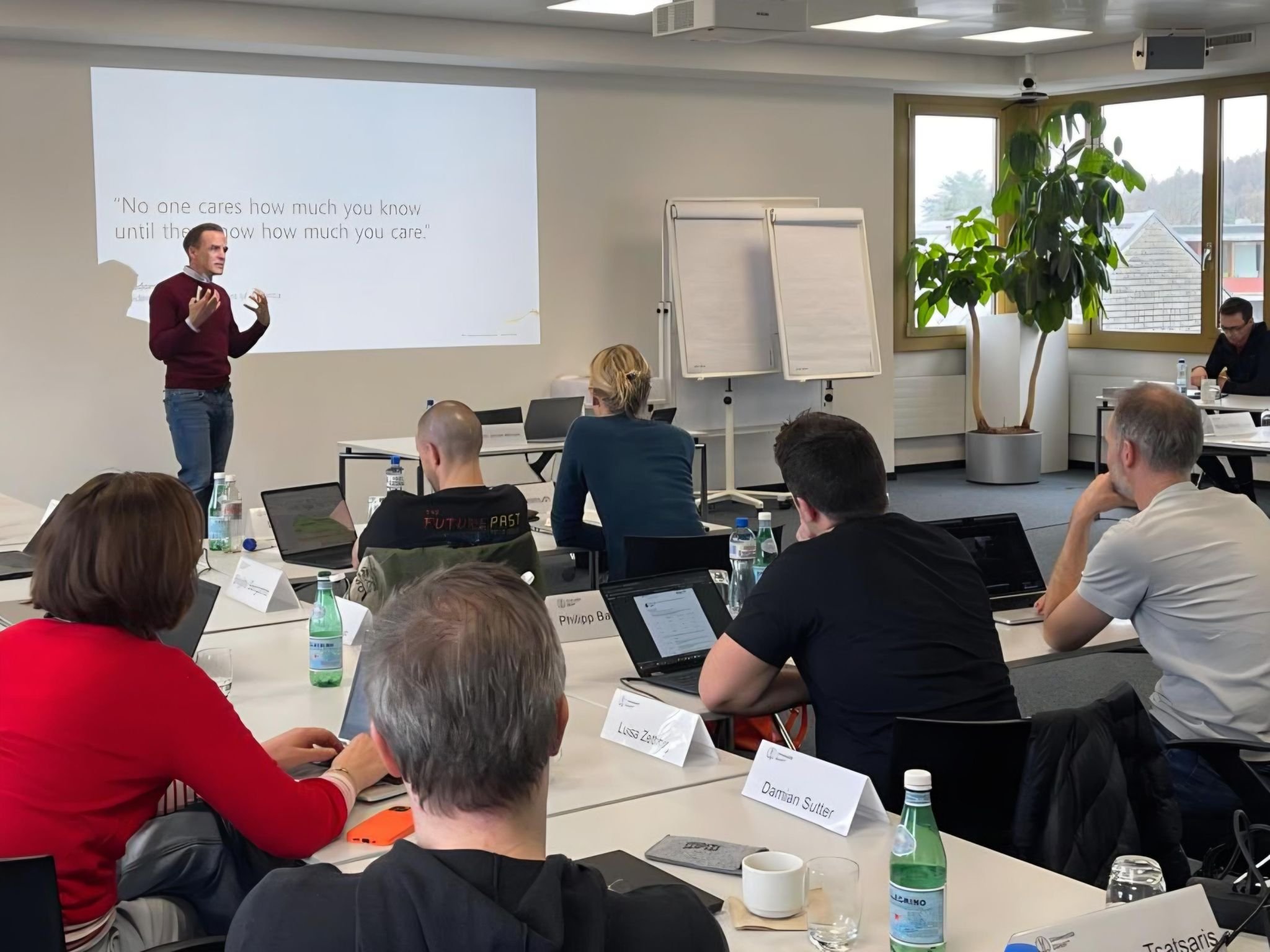
Leading AI
Leading AI
Zurich (Switzerland) — 3 April 2026
AI is the first technology we don’t just use -- we must lead it.
💡 Unlike any tool before, AI anticipates, suggests, and sometimes makes decisions for us. In chats, it takes us down a certain route. That’s its power, and its danger. Without leadership, we risk being led -- into efficiency without reflection, with intelligence but without imagination.
Thus, users must learn to lead in order to engage with AI wisely.
➡️ Start with intention. Before you prompt, ask yourself: What do I really want to achieve? AI should amplify your direction, not determine it.
➡️ Stay intellectually present. Don’t outsource your thinking. Challenge outputs, reframe questions, and resist the temptation of the “first good answer.” What may sound good may ultimately not be good.
➡️ Invite divergence, not just convergence. Ask AI to generate alternatives, tensions, even contradictions. Look for blind spots -- what is AI missing that may be important to you? Leadership means expanding the space of possibilities, not narrowing it too quickly.
➡️ Hold on to judgment. AI can inform decisions, but it should not make them. You should make them, based on your priorities and your values -- not on the ones embedded in the web of associations that AI draws from. And if you can't, talk to trusted humans for advice.
➡️ Don't be an echo of AI. Develop and use your own voice. The more you use AI, the more important it becomes to know what is distinctly yours -- your perspective, your conscience, your way of seeing the world.
In the past, my courses were mostly about leading people. But increasingly, leadership is also about how we relate to technology -- and how we shape it before it shapes us.
Related Articles